
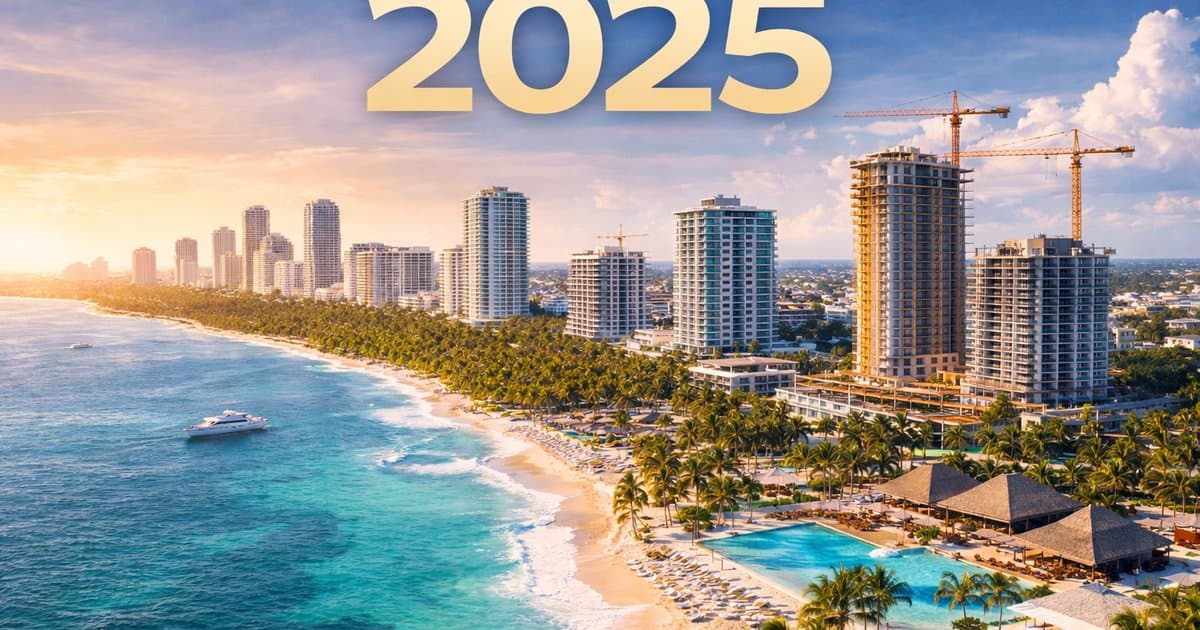
SANTO DOMINGO, Dominican Republic — As the sun set on 2025, the Dominican Republic closed out one of its most consequential years in recent memory — a period defined by record-setting tourism, robust investment flows, impactful legal reforms, and structural shifts that will influence its real estate, economic and social landscapes for years to come.
What follows is a synthesis of the most important developments that shaped the year, orienting professionals and investors toward the opportunities, risks, and structural shifts that now define the Dominican market.
Tourism: Records and New Benchmarks
One of the year's standout achievements was the exceptional performance of the tourism sector. By late November, official counts confirmed that the country had welcomed over 10.28 million visitors, on pace for a historic annual total. Officials projected that the run rate could surpass 12 million arrivals by year‑end, a remarkable rebound and expansion for a destination still outpacing pre‑pandemic metrics. This surge had clear implications for real estate demand. Coastal and resort areas such as Punta Cana, Bávaro, Samaná and the North Coast witnessed heightened interest for short‑term rental assets, mixed‑use developments and luxury inventory, as investors rebalanced portfolios toward tourism‑linked opportunities.
Real Estate Market Evolution: Demand, Prices and New Projects
The residential property market sustained its upward movement throughout 2025. By mid‑year, average prices had climbed by double digits compared with 2024, reflecting both local demand and inflows of foreign capital. Projections for year‑end continued to signal moderate growth in pricing across key markets.
On the project front, high‑profile investments captured international attention. Among them, a US$1 billion luxury tourism and residential development led by a prominent investor in the north — featuring hundreds of ultra‑high‑end villas and condominiums — underscored the country's appeal to global capital and high net‑worth buyers. Institutional investors also diversified beyond hospitality and residential sectors, looking at renewable energy, logistics and industrial real estate as long‑term structural trends supporting broader economic growth.
Economic Strength and Labor Markets
Behind the headlines, underlying economic indicators kept pace with the country's outward momentum. Between January and November, the economy continued to absorb strong labor market performance, with nearly 120,000 new jobs created in sectors such as commerce, industry and services — a testament to sustained domestic demand and business expansion. Free Trade Zones remained a major employment engine, surpassing 200,000 jobs for the first time in history, further anchoring the DR's status as a regional hub for manufacturing and export services.
These dynamics dovetailed with external assessments identifying the Dominican Republic as one of the most attractive destinations for foreign direct investment in Latin America — supported by reforms to corporate governance, legal frameworks for investment, and progressive tax and incorporation regimes.
Policy, Regulation and Institutional Integrity
2025 was also marked by institutional developments with implications for transparency and the investment climate. Mid‑year saw the introduction of a new national rental law — a substantial update to regulations that had not been significantly revised in decades, reshaping tenant‑landlord relations and eviction processes.
In the judicial arena, the highly publicized Caso SeNaSa — a corruption investigation into the national health insurance authority — drew attention to issues of governance and oversight, prompting executive action and signaling that accountability remains a key narrative in public administration. Collectively, these developments reinforced the perception that the Dominican Republic is not simply chasing growth, but is actively seeking institutional quality and rule‑based governance, factors that increasingly influence investment decisions.
Infrastructure, Energy and Resilience
Beyond tourism and real estate, energy and infrastructure were quietly but steadily evolving. Renewable energy projects advanced, including the expansion of solar power capacity through new photovoltaic installations that now contribute significantly to the national grid — diversifying the energy mix and improving reliability. Yet not all infrastructure news was entirely positive. In November, the country experienced a nationwide blackout that disrupted transportation, work, and services, highlighting lingering vulnerabilities in grid stability even as the country transitions toward cleaner and more diversified power sources.
Public Safety and Social Impact
The year was also tinged with somber events. A tragic roof collapse at a historic nightclub in Santo Domingo resulted in one of the deadliest non‑natural disasters in modern Dominican history, leaving a profound mark on the nation's collective consciousness and raising questions about construction standards and public safety oversight. While not directly tied to investment or real estate, the social ripple effects of such tragedies influence quality‑of‑life assessments that investors and expatriate residents increasingly factor into long‑term decisions.
Outlook: 2026 and Beyond
As 2025 draws to a close, key indicators point toward sustained—but more nuanced—momentum going into 2026. Growth projections hover in the 4–5% range, underpinned by strong fundamentals and continued diversification of investment flows. For real estate investors and economic stakeholders, the message is clear: the Dominican Republic offers a compelling mix of macro stability, tourism‑driven demand, expanding infrastructure, and improving governance frameworks — but opportunities now demand sophistication. Success will increasingly depend on understanding regional dynamics, zoning and regulation, infrastructure constraints, and sector‑specific risks.
Conclusion
The story of 2025 in the Dominican Republic is one of expansion, adaptation and maturity. Tourism broke records, investors went beyond traditional beachfront markets, and economic reform and institutional quality advanced in measurable ways. But the year also reminded stakeholders that sustainable growth must be paired with public safety, infrastructure reliability, and legal clarity. For investors and professionals in real estate and related sectors, 2025 was not just another growth year — it was a transition year, signaling that the Dominican Republic is maturing into a market with depth, structure and long‑term investment appeal.
Explore the Market
Explore the Dominican Republic's real estate market firsthand.
Browse properties for sale